Remark
The solutions in this CAT were to be made using RMarkdown. To read more about RMarkdown access the information here
Question 1
Define an Algorithm and state the various conditions than an algorithm ought to satisfy
An algorithm can be defined as any well-defined computational procedure that takes some values as input and produces some values as output.
Every algorithm must satisfy the following criteria:
Input There are zero or more quantities which are externally supplied
Output At least one quantity is produced
Defineteness If we trace out the instructions of the algorithm, then for all the cases the algorithm will terminate after a finite number of steps
Effectiveness every instruction must be sufficiently basic that it can in principle be carried out by a person using only a pencil and a paper
What are the three components of a function in R
A function has three parts:
formals()the list of arguments that control how you call the functionbody()the code inside the functionenvironment()the data structure that determines how the function finds the values associated with the names
Give the code on how you create a new column in a dataset in R and Python based on some condition.
R code
# assuming the data frame named mtcars in R

library(dplyr) # package for manipulation

# divide the disp of the car by 100

mtcars <- mtcars %>%
  mutate(disp_10 = disp/10)
knitr::kable(head(mtcars))| mpg | cyl | disp | hp | drat | wt | qsec | vs | am | gear | carb | disp_10 | |
|---|---|---|---|---|---|---|---|---|---|---|---|---|
| Mazda RX4 | 21.0 | 6 | 160 | 110 | 3.90 | 2.620 | 16.46 | 0 | 1 | 4 | 4 | 16.0 |
| Mazda RX4 Wag | 21.0 | 6 | 160 | 110 | 3.90 | 2.875 | 17.02 | 0 | 1 | 4 | 4 | 16.0 |
| Datsun 710 | 22.8 | 4 | 108 | 93 | 3.85 | 2.320 | 18.61 | 1 | 1 | 4 | 1 | 10.8 |
| Hornet 4 Drive | 21.4 | 6 | 258 | 110 | 3.08 | 3.215 | 19.44 | 1 | 0 | 3 | 1 | 25.8 |
| Hornet Sportabout | 18.7 | 8 | 360 | 175 | 3.15 | 3.440 | 17.02 | 0 | 0 | 3 | 2 | 36.0 |
| Valiant | 18.1 | 6 | 225 | 105 | 2.76 | 3.460 | 20.22 | 1 | 0 | 3 | 1 | 22.5 |
Python code
import pandas as pd

#create DataFrame
df = pd.DataFrame({'team': ['A', 'A', 'A', 'A', 'B', 'B', 'B', 'B'],
                   'points': [30, 22, 19, 14, 14, 11, 20, 28]})

#add new column to DataFrame that shows mean points by team

df['mean_points'] = df.groupby('team')['points'].transform('mean')

#view updated DataFrame

print(df)
team points mean_points
0 A 30 21.25
1 A 22 21.25
2 A 19 21.25
3 A 14 21.25
4 B 14 18.25
5 B 11 18.25
6 B 20 18.25
7 B 28 18.25Question 4
Pick either one of these dataset from ggplot2
midwestdata from midwest counties from the 2000 censuseconomics_longdata on US economic time series
Use this dataset to:
Plot of counts by discrete variable
R Code
library(ggplot2)

# visualization on the number of black people in each county

midwest %>%
  group_by(state) %>%
  summarize(total_bl = sum(popblack)) %>%
  ggplot(aes(x = reorder(state, -total_bl), y = total_bl)) +
  geom_bar(stat = "identity", width = 0.2, fill = "blue")+
  theme_minimal() + labs(x = "State", y = "Total Black Population")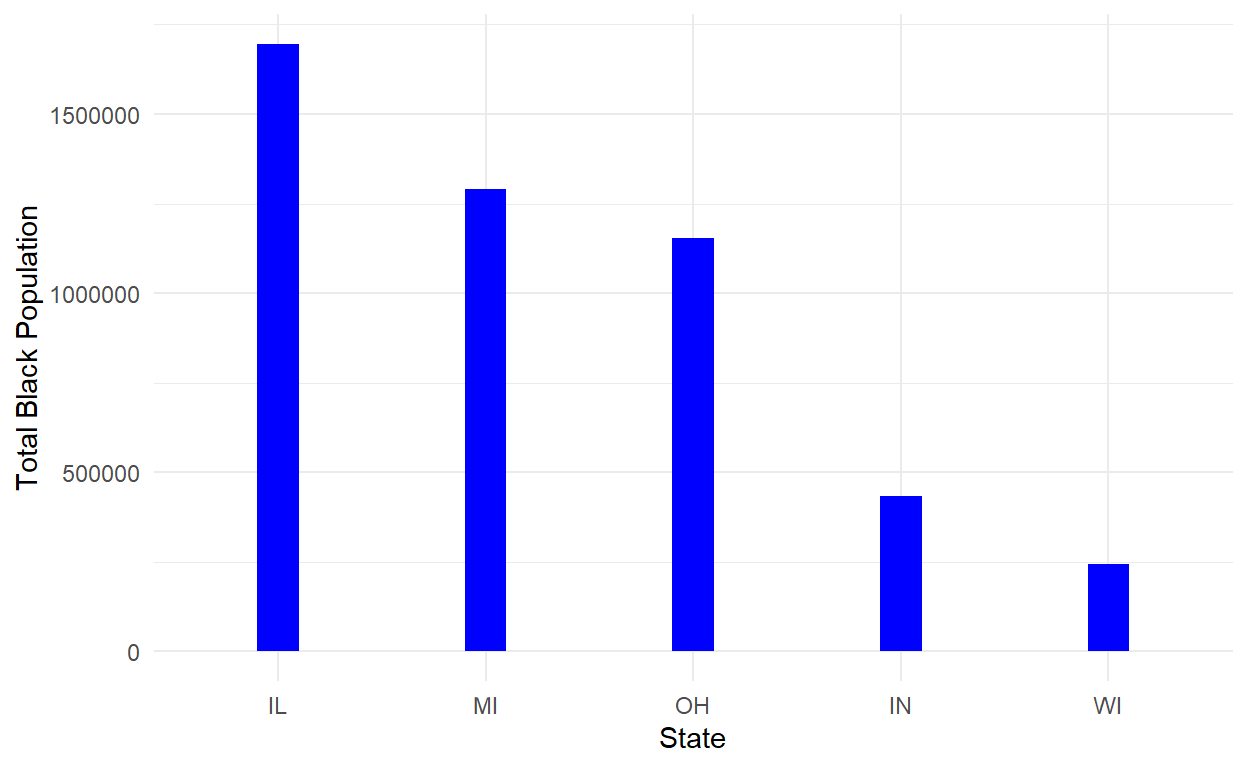
a histogram or density of a continuous variable
# histogram of population density

midwest %>%
  ggplot(aes(x = popdensity)) + geom_histogram(bins = 10) +
  theme_minimal()+labs(x = "Population Density", y = "Frequency")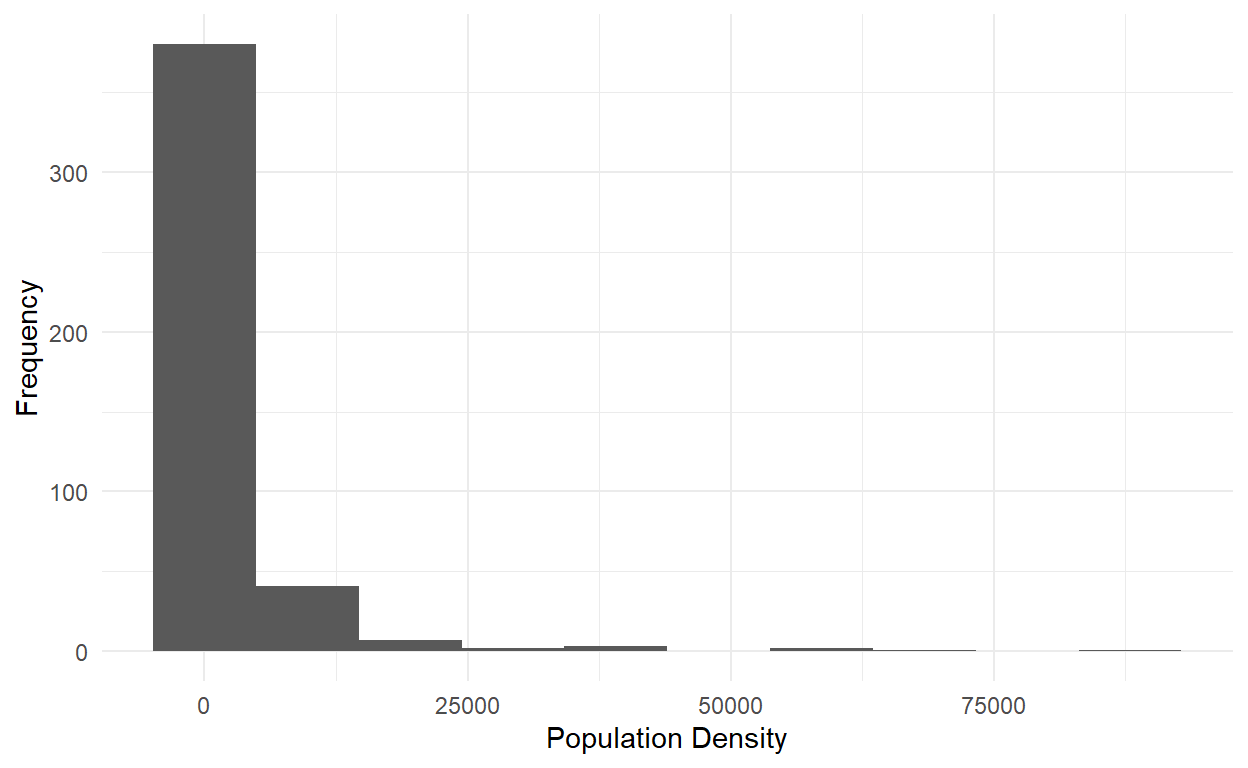
# density

midwest %>%
  ggplot(aes(x = popdensity)) + geom_density(stat = "density", fill = "green") + labs(x = "Population Density", y = "Density")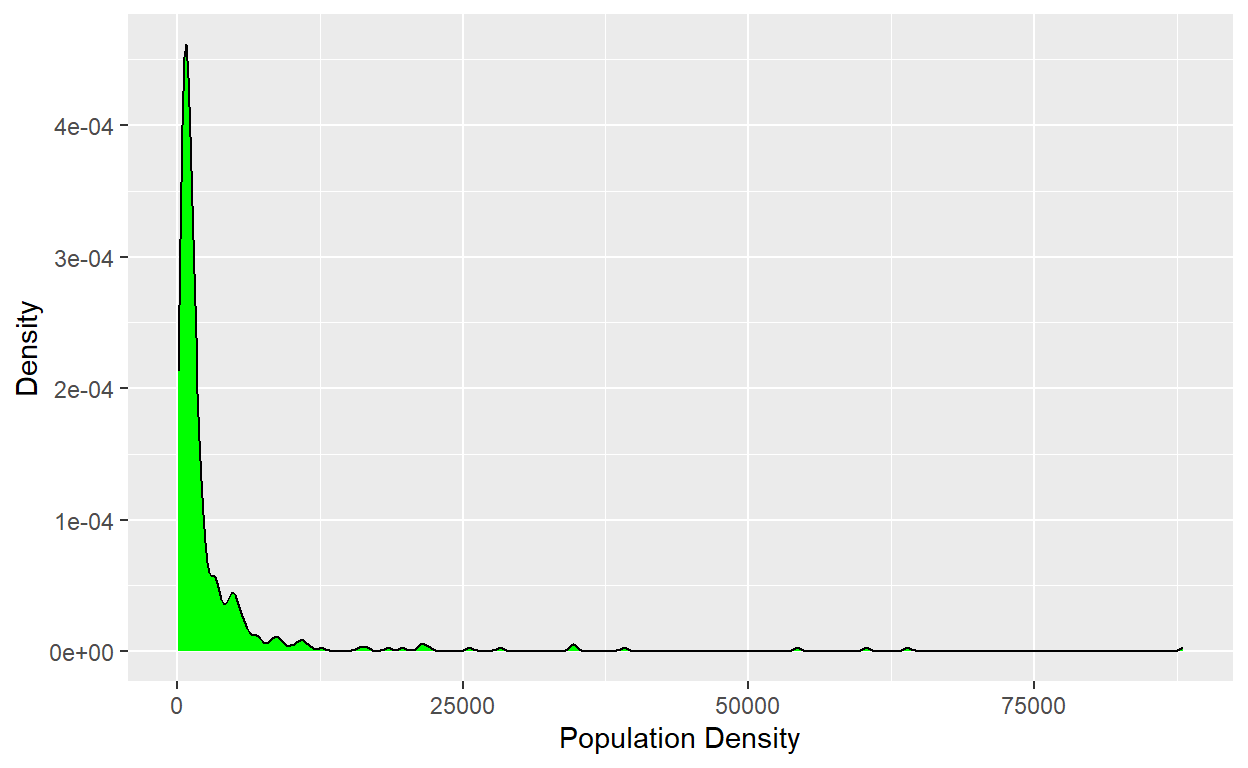
a summary statistic of a continuous variable for each value of a discrete variable
out <- midwest %>%
  group_by(state) %>%
  summarize(Mean = mean(poptotal),
            Median = median(poptotal),
            Maximum = max(poptotal),
            Minimum = min(poptotal))
knitr::kable(out)| state | Mean | Median | Maximum | Minimum |
|---|---|---|---|---|
| IL | 112064.73 | 24486.5 | 5105067 | 4373 |
| IN | 60262.60 | 30362.5 | 797159 | 5315 |
| MI | 111991.53 | 37308.0 | 2111687 | 1701 |
| OH | 123262.67 | 54929.5 | 1412140 | 11098 |
| WI | 67941.24 | 33528.0 | 959275 | 3890 |
# visual representation

midwest %>%
  ggplot(aes(x=state, y = poptotal)) + geom_boxplot()+ theme_minimal()+
  labs(y = "Population Total")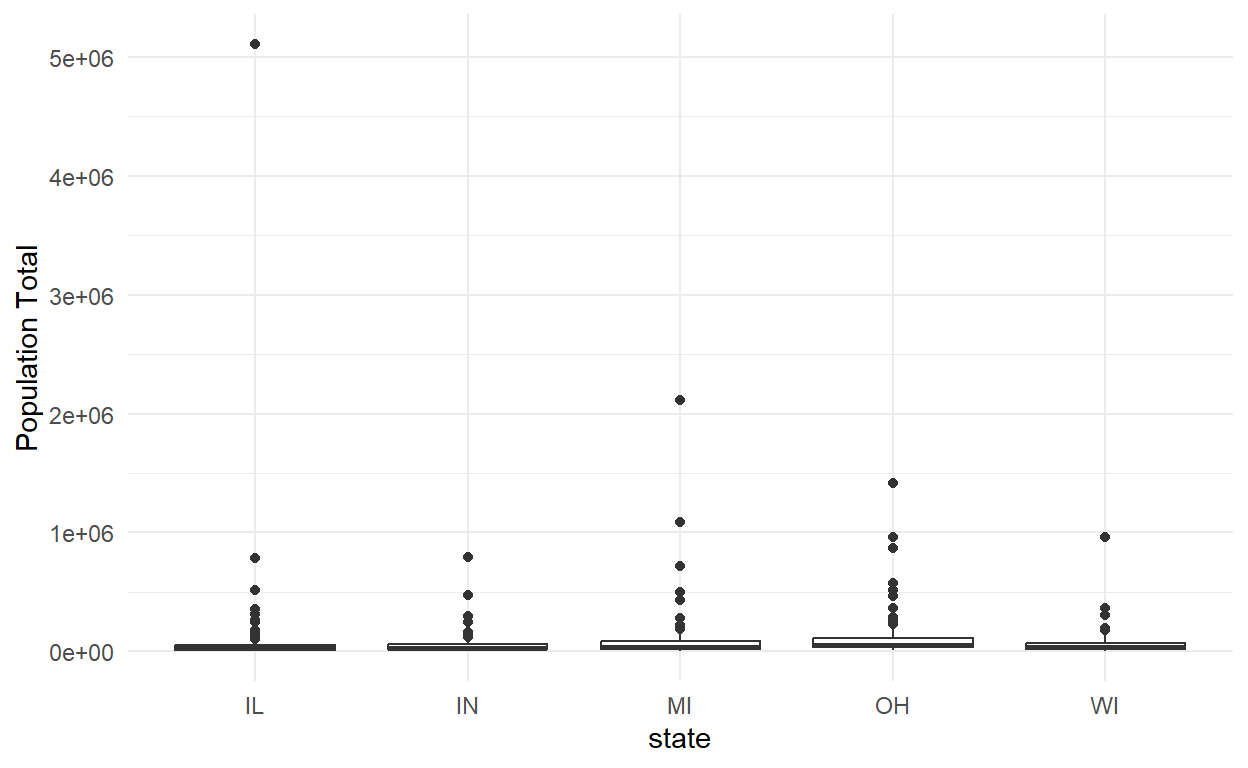
a scatterplot of two continuous variables, with a smoothed conditional mean line.
# we explore poppovertyknown and percollege

midwest %>%
  ggplot(aes(x = percollege, y = percbelowpoverty)) +
  geom_point() + geom_smooth(method = "lm")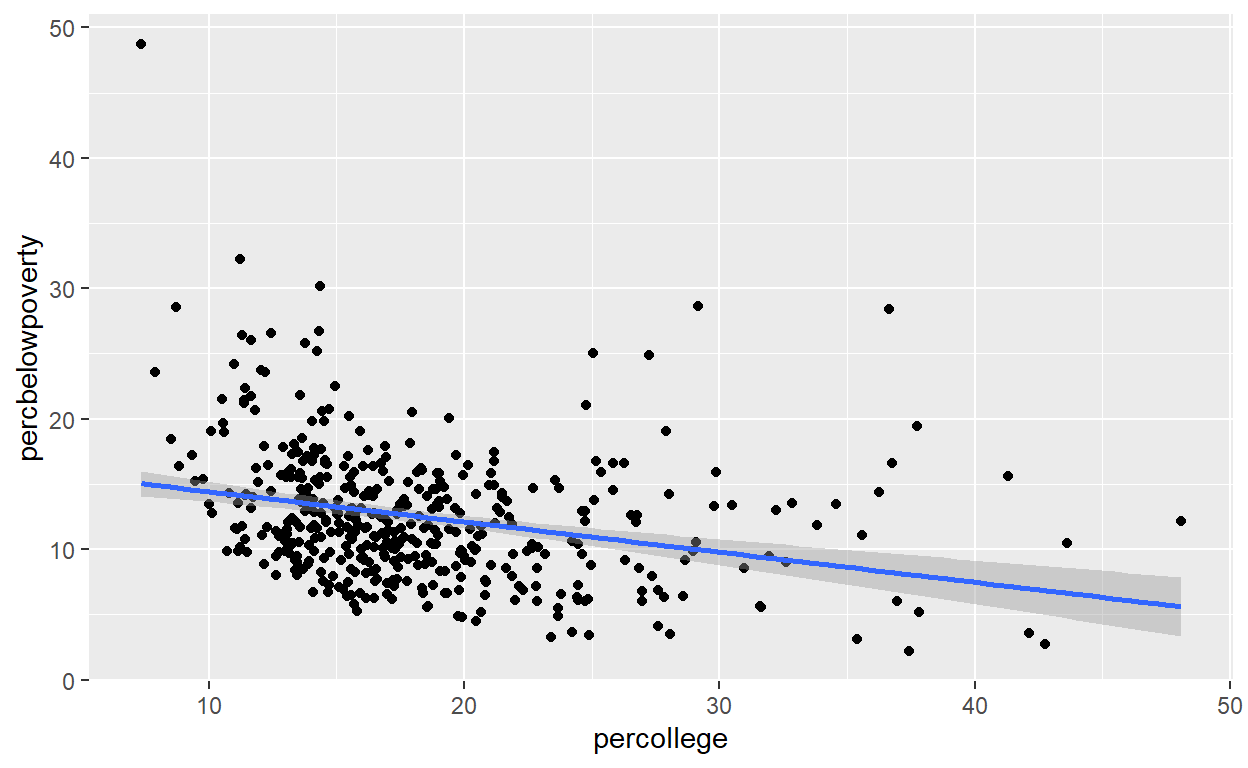
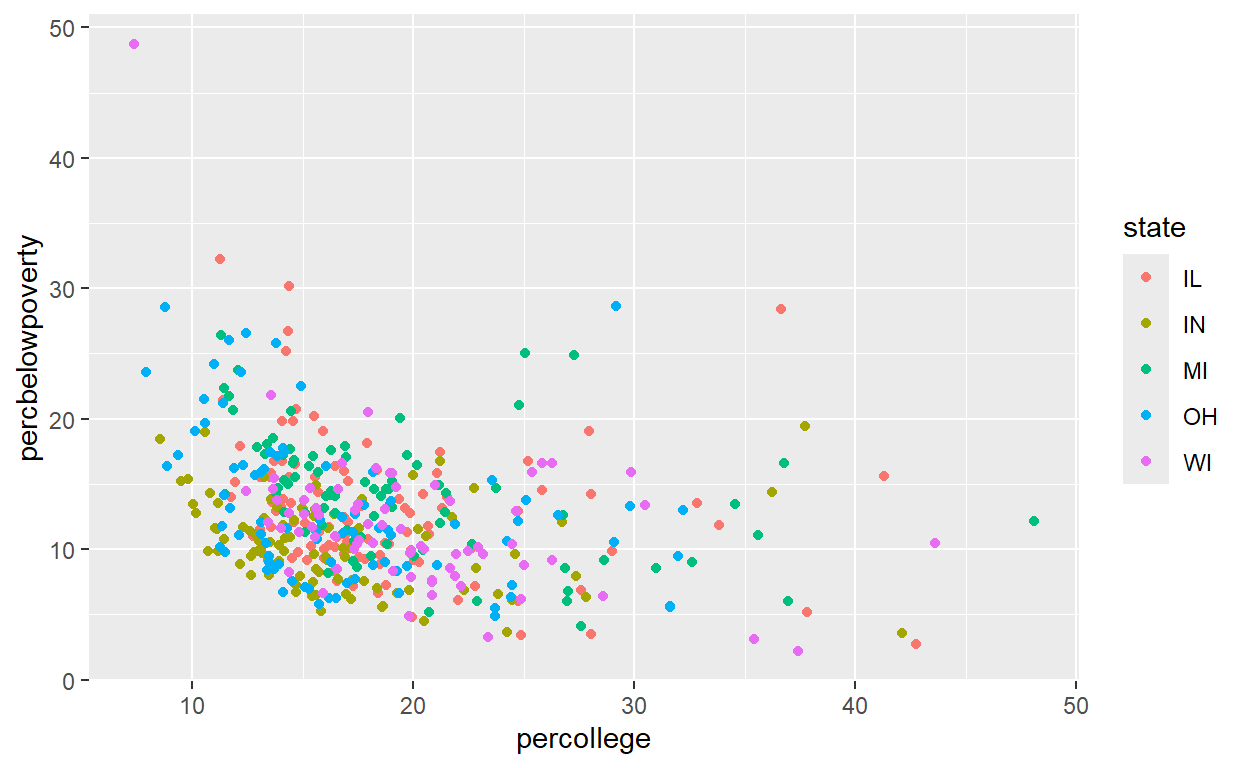
three variables.
midwest %>%
  ggplot(aes(x = percollege, y = percbelowpoverty,color = state))+
  geom_point()